Monday, July 23, 2018

Simon says and friends

I say that a good seminar is the one when you take away at least one new idea / teaching method/ game etc. The last seminar that I attended a couple of months ago was organized by Oxford University Press and I can say that it was great because I learned many new things that I could use with my students immediately. The most interesting for me was the "updated" version of the well known game "Simon says". I tried it with my 5th grade students (around 10 years old) and I can say that it was really really fun.
This is how it goes.
You ask the class to stand up. It's good if you can organize the classroom so that there is enough free space for the students to move around. It is helpful if you could provide pictures for each character that is involved in the game. First you start with Simon. I forgot the pictures I had had prepared at home so I had to improvise right before the lesson which wasn't so bad after all :) I put the pictures on the board and explained the simple rules to the students. When I say : Simon says touch your nose - everybody should do this, if I don't say Simon says but still say touch your nose you are out of the game. 
This is Simon 

The next character that joins the game is Speedy Suzie. As the name itself implies when the students hear her name they should perform the activity in a fast manner. 
This is Speedy Suzie

Then comes Lazy Lucy and she does everything in a very slow way.

And finally Opposite Jack who does everything in the opposite way.


You can watch the video and see how all of this works in practice. As you can see the students were super excited and we really had a lot of fun.
I hope you'll find this interesting enough to use it in your classroom, too.
I would like to hear from you so feel free to express your thoughts in the comment box below. Let me know if you are familiar with other "updated versions" of other games. 

Here's a link to the video
https://www.youtube.com/watch?v=TduWn7QFsrI&feature=youtu.be


Thursday, June 16, 2016

Health and illnesses - booklet

The students worked in pairs and created these booklets on health and illnesses vocabulary. The aim of the lesson was to practice the key vocabulary and the modal verb - should/ shouldn't.
The students provided pictures and gave a suitable advice for each problem. Then they continued working in pairs by asking each other what to do with a certain health problem.


Making a fashion catalogue - present continues and clothes vocabulary revision

To revise present continuous and clothes vocabulary we decided to create some fashion catalogues. We used different magazines to choose the clothes for the models in the catalogue and once they were done the student described what each person wore.


Creating cards / learning materials - verbs

In my last  few posts I want to show how I work closely with my students in creating learning materials together. The aim for this lesson was to revise verbs. These are third grade students and they are just starting to learn how to read and write,
The English Adventure book is used in this grade and I find it really interesting and useful. Especially useful are the cards in the back of the book. I use them for different activities which make learning English more amusing for the students.
I started the lesson by asking the students to cut the cards from the back of the book.
Then I asked them to make paper word cards.


Next, each student had to match the words with the pictures. 


In the end I asked the students to work in pairs and check each other's matching.


Wednesday, January 27, 2016

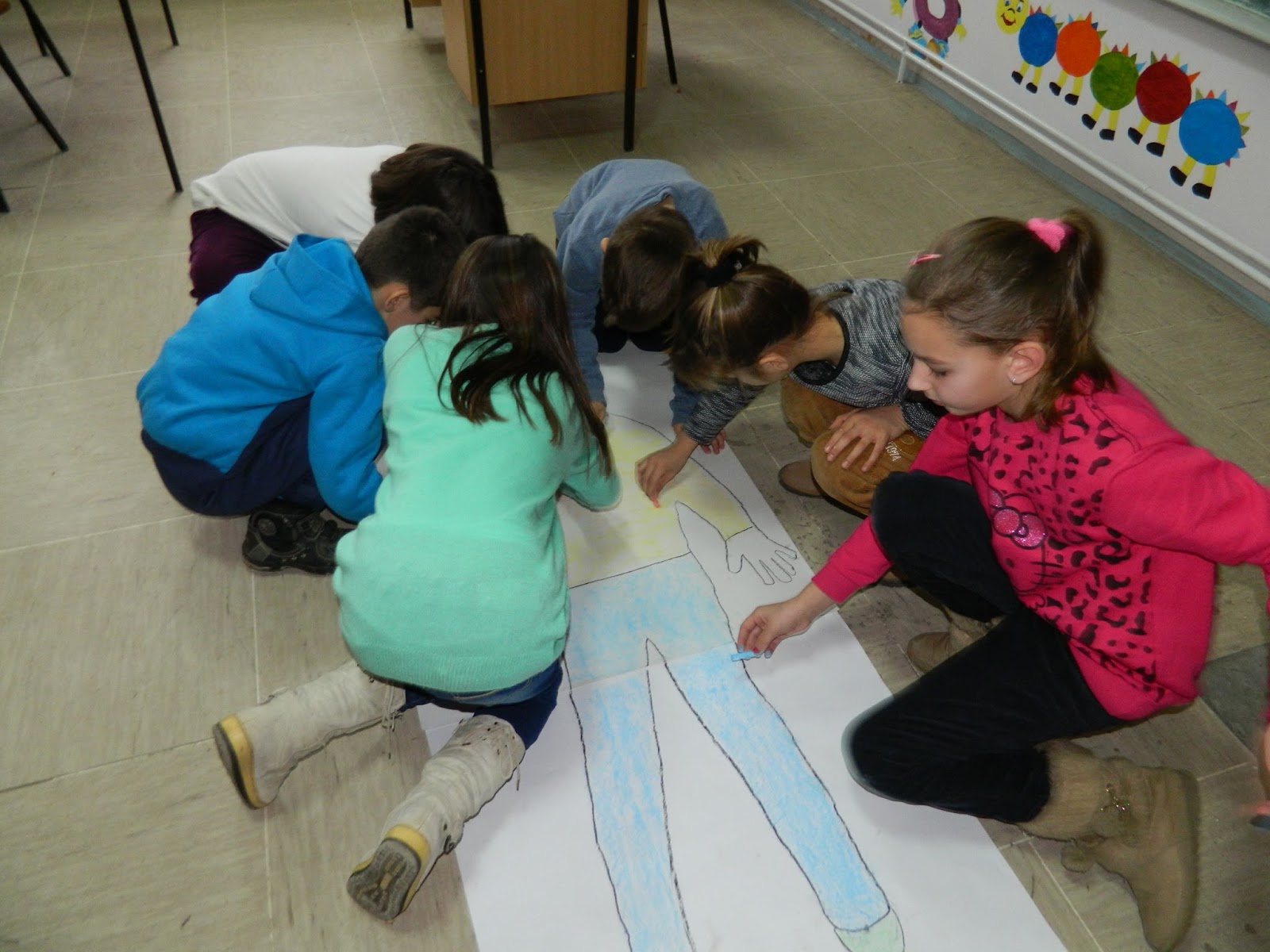
Creating a poster - revising body parts

I like to engage my students as much as possible both in the learning process and in the creation of the learning/ teaching materials.
On this lesson we did some revision and created a poster with parts of the body that can be used on other lessons in the future that deal with the same set of words.

1. Warm up:  To start the lesson I decided to do a quick TPR activity - listen and do. The teacher names the part of the body and the students point to it. Or the teacher can include some verbs together with the body parts and ask the students to move.

2. Main part: I prepared one poster big enough for a student to lie on. I gave the instructions to the students how to draw a boy on the poster. Then we colored it and decorated it.
2.1 I gave the students some pieces of paper with parts of the body vocabulary written on them. There was one letter missing in each word. The students had to guess the word on the piece of paper, complete the spelling, then put the word on the correct place on the poster and spell the word.


3. End of class activity - It's always good to finish the lesson on a positive note. Young learners love music and dancing. I played some music in the background but I asked the students to dance according to what I said. They had to follow the rhythm of the music but dance "head to head" or "arm to arm" with their partner.