Showing posts with label fun with grammar. Show all posts
Thursday, June 16, 2016
Thursday, January 14, 2016
Asking questions using gerund (presentation and practice)
The aim of this lesson is introducing gerund for making questions.
This lesson follows the one posted previously when the students were introduced with the affirmative and negative form of gerund.
1. I started the lesson by delivering the flash cards to the students from the previous lesson in order to revise affirmative and negative sentences using gerund. Then I introduced how questions are made for each person respectfully. Make sure that you elicit as much as possible from the students while writing down the examples on the board.
This lesson follows the one posted previously when the students were introduced with the affirmative and negative form of gerund.
1. I started the lesson by delivering the flash cards to the students from the previous lesson in order to revise affirmative and negative sentences using gerund. Then I introduced how questions are made for each person respectfully. Make sure that you elicit as much as possible from the students while writing down the examples on the board.
2. In order to practice asking questions I decided to do a class survey. I gave the students the instructions and then allowed them to stand up, walk around and interview each other. Once they finished with the survey we put the results on the board. Be sure to expect a bit of a noisy classroom but it's all part of learning and having fun :)
3. In the end we practiced some more speaking by playing a game. I made this paper crown by myself and the cards used in the game too. I got the idea from the game Hedbanz, but I adapted it to my students' needs. It's fun and serves the purpose right. The good thing about it is that you can use it with different questions (tense) and different vocabulary.
Monday, April 13, 2015
Reading - ideas on how to organize a lesson
This is a lesson I did in the fifth grade. The unit deals with going to for expressing future and the topic of holidays and camping. I came up with two simple texts so that I can do some group work. This is what we did.
Warm up activity - revision of the vocabulary about sport. Put some flashcards on the board and ask students to work in two groups. Make sentences on pieces of paper and ask students to run to the board and stick the sentences on the correct pictures. You can measure the time and turn the activity into an amusing game. With this activity you revise sport, going to, plus you make students move around and have fun while learning.
Main activity - Students work in two groups. They need to read a text and replace the pictures in the text with words. Then they fill in another worksheet by answering some questions related to the text.
To check if the students in the groups understood the texts ask two representatives, one from each group to come to the board, answer the questions and fill in the Venn Diagram. The other members from the groups can also help if needed.
End of class activity - Ask students to work in pairs. Give them a piece a paper, ask them to fold it in half, then again, and again and again:) Then ask them to write a sentence using going to, by writing one word in each square. Then they cut the pieces, mix the pieces of paper and give them to another pair. They are expected to create a sentence. It saves teacher's time for preparing cards for the lesson and it's fun for the kids.
Warm up activity - revision of the vocabulary about sport. Put some flashcards on the board and ask students to work in two groups. Make sentences on pieces of paper and ask students to run to the board and stick the sentences on the correct pictures. You can measure the time and turn the activity into an amusing game. With this activity you revise sport, going to, plus you make students move around and have fun while learning.
Main activity - Students work in two groups. They need to read a text and replace the pictures in the text with words. Then they fill in another worksheet by answering some questions related to the text.
End of class activity - Ask students to work in pairs. Give them a piece a paper, ask them to fold it in half, then again, and again and again:) Then ask them to write a sentence using going to, by writing one word in each square. Then they cut the pieces, mix the pieces of paper and give them to another pair. They are expected to create a sentence. It saves teacher's time for preparing cards for the lesson and it's fun for the kids.
Saturday, March 28, 2015
Introducing adjectives
This is a lesson I did in the second grade. The lesson aim is introducing adjectives and their use in a sentence.
Lesson plan
Warm up activity:
1. Show students flash cards with the animals you have taught them previously and ask them to name the animals.
2. Give each student a flash card a ask them to say a whole sentence. ex. It's a bear / It's a lion
3. Put the flash cards on different walls in the classroom and play the game listen and point. Students listen to the word and they point to the correct picture.
Main part:
1. Put some pictures of animals on the board (bear, elephant, spider, snake and a giraffe). Show students cards with adjectives ( big, fat, tall, long, small) Try to elicit from the student which adjective best describes each animal. Repeat the words several times so that they practice the pronunciation and then make whole sentences. It's a big bear/ It's a fat elephant.
2. Use animal toys and give one toy to each student. Make cards with the adjectives written on them and put them around the classroom. Ask students to walk around the classroom and find one adjective that can be used to describe their animal. Make sure that you give them different animals now from the ones that are on the board. You can give them hippo-fat; rhino-fat; crocodile -long; bird/fish-small. etc. After they find the best adjective for their toy ask them to stand in a line and make a sentence with the adjective - It's a long crocodile. Help them out when necessary.
3. Write a sentence on the board- It's a big bear. Elicit the word order in the sentence and ask students to remember it. Prepare a poster with post it notes. Write jumbled up sentences and ask students to come to the board, one by one, and put the words in the correct order by re- arranging the post it notes. After they put them in the correct order, ask them to read the sentence out loud. Or if they find it too demanding help them out with the pronunciation.
End of class activity:
To finish the lesson in a positive note. sing the song The elephant walks like this and that...
Point out the adjectives in the song and make sure students remember them.
Enjoy your lesson!
Lesson plan
Warm up activity:
1. Show students flash cards with the animals you have taught them previously and ask them to name the animals.
2. Give each student a flash card a ask them to say a whole sentence. ex. It's a bear / It's a lion
3. Put the flash cards on different walls in the classroom and play the game listen and point. Students listen to the word and they point to the correct picture.
Main part:
1. Put some pictures of animals on the board (bear, elephant, spider, snake and a giraffe). Show students cards with adjectives ( big, fat, tall, long, small) Try to elicit from the student which adjective best describes each animal. Repeat the words several times so that they practice the pronunciation and then make whole sentences. It's a big bear/ It's a fat elephant.
2. Use animal toys and give one toy to each student. Make cards with the adjectives written on them and put them around the classroom. Ask students to walk around the classroom and find one adjective that can be used to describe their animal. Make sure that you give them different animals now from the ones that are on the board. You can give them hippo-fat; rhino-fat; crocodile -long; bird/fish-small. etc. After they find the best adjective for their toy ask them to stand in a line and make a sentence with the adjective - It's a long crocodile. Help them out when necessary.
3. Write a sentence on the board- It's a big bear. Elicit the word order in the sentence and ask students to remember it. Prepare a poster with post it notes. Write jumbled up sentences and ask students to come to the board, one by one, and put the words in the correct order by re- arranging the post it notes. After they put them in the correct order, ask them to read the sentence out loud. Or if they find it too demanding help them out with the pronunciation.
End of class activity:
To finish the lesson in a positive note. sing the song The elephant walks like this and that...
Point out the adjectives in the song and make sure students remember them.
Enjoy your lesson!
Thursday, March 26, 2015
Introducing the difference between present simple and present continuous
Warm up activity : start the lesson by showing some jobs flashcards and ask students to name them (doctor, policeman, chef..) Distribute the cards to the students and ask them to say a whole sentence introducing the person on the card: He is a chef. He works in a restaurant.
Man part of the lesson:
1. Tell them a short story about a person on one of the cards: This is Tom. He is 36 years old. He lives in Skopje. He is a doctor. He works in a hospital every day but he is working in the garden now.
Divide the board in two columns and write a heading PRESENT SIMPLE / PRESENT CONTINUOUS in each respectively . Then write the two sentences in the appropriate column and explain the difference between the two sentences and between the two columns. Write few more examples and elicit the answers from the students. Make them draw a conclusion on how we use the two present tenses.
Ex. This is Masid. He is a chef. He makes pizza every day. He is making a pizza now.
This is Lucy. She is a footballer. She plays football everyday. She is playing tennis in the park now.
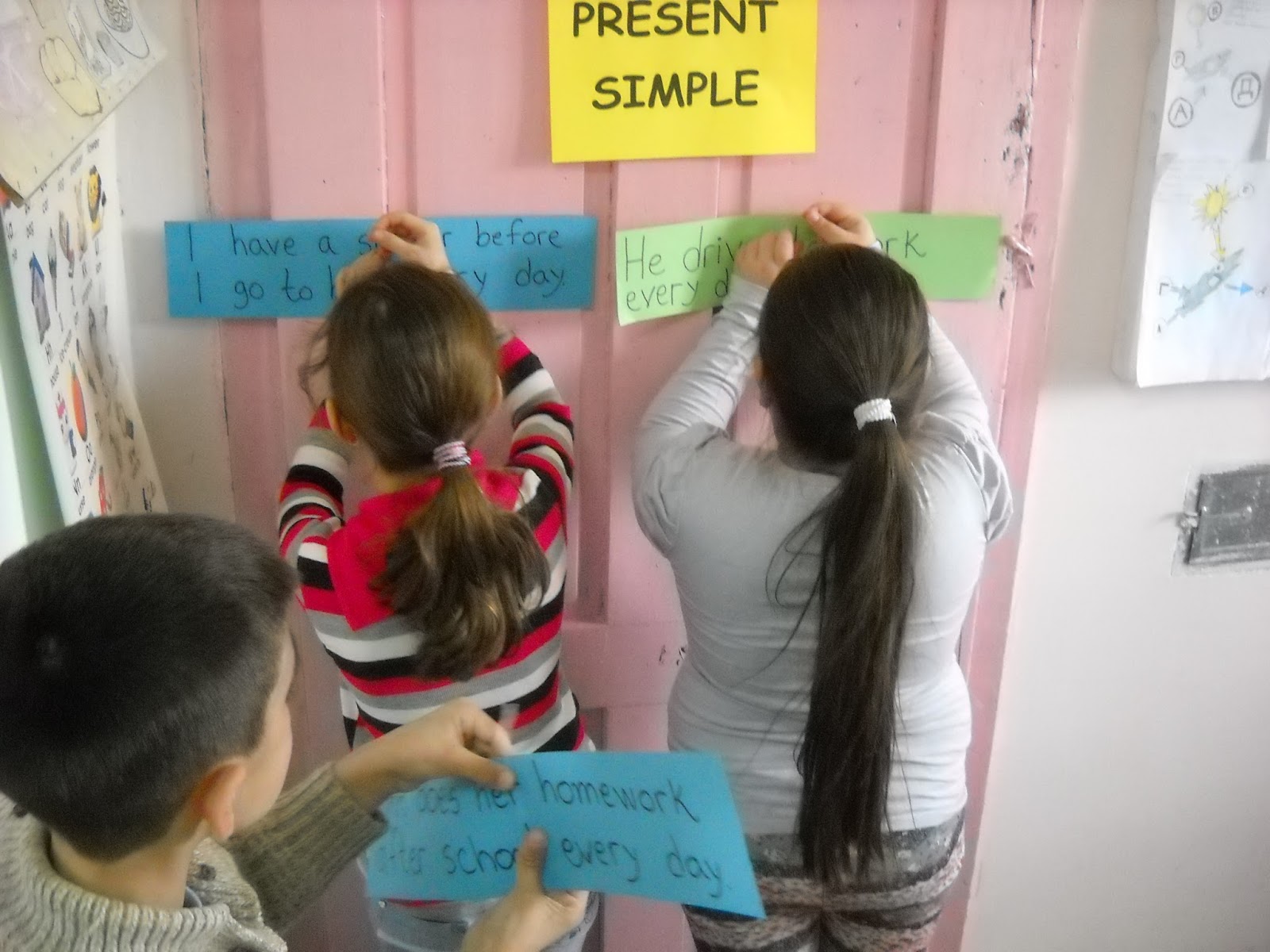
2. Put two pieces of paper with the names of the tenses on different walls in the classroom. Then give students large pieces of paper with sentences written on them. Ask students to move around the classroom and put their sentences under the correct heading - PRESENT SIMPLE OR PRESENT CONTINUOUS. Once they identify the tense of their sentence ask them to read it out loud and explain what made them put the sentence in that category.
3. Prepare a poster with sentences in present simple and present continuous. Make small pieces of paper with the words every day and now. Ask students to come up to the board, read a sentence, finish it my adding one of the words and then talk about his/ her decision.
Man part of the lesson:
1. Tell them a short story about a person on one of the cards: This is Tom. He is 36 years old. He lives in Skopje. He is a doctor. He works in a hospital every day but he is working in the garden now.
Divide the board in two columns and write a heading PRESENT SIMPLE / PRESENT CONTINUOUS in each respectively . Then write the two sentences in the appropriate column and explain the difference between the two sentences and between the two columns. Write few more examples and elicit the answers from the students. Make them draw a conclusion on how we use the two present tenses.
Ex. This is Masid. He is a chef. He makes pizza every day. He is making a pizza now.
This is Lucy. She is a footballer. She plays football everyday. She is playing tennis in the park now.
2. Put two pieces of paper with the names of the tenses on different walls in the classroom. Then give students large pieces of paper with sentences written on them. Ask students to move around the classroom and put their sentences under the correct heading - PRESENT SIMPLE OR PRESENT CONTINUOUS. Once they identify the tense of their sentence ask them to read it out loud and explain what made them put the sentence in that category.
3. Prepare a poster with sentences in present simple and present continuous. Make small pieces of paper with the words every day and now. Ask students to come up to the board, read a sentence, finish it my adding one of the words and then talk about his/ her decision.
4. Make another poster with sentences but make sure that there is a mistake in each sentences. Ask students to come up to the board and correct the sentences and explain why the mistake needs to be corrected.
End of class activity:
Finish the lesson by playing charade where one by one students act out a profession and the rest of the students guess the word. Or they can even form a whole sentence in the present continuous.
Ex,You are cooking / You are a doctor / You are running.
Subscribe to:
Posts (Atom)